


NFL refs have set all-time record for flags this season, and it's changing the outcome of games

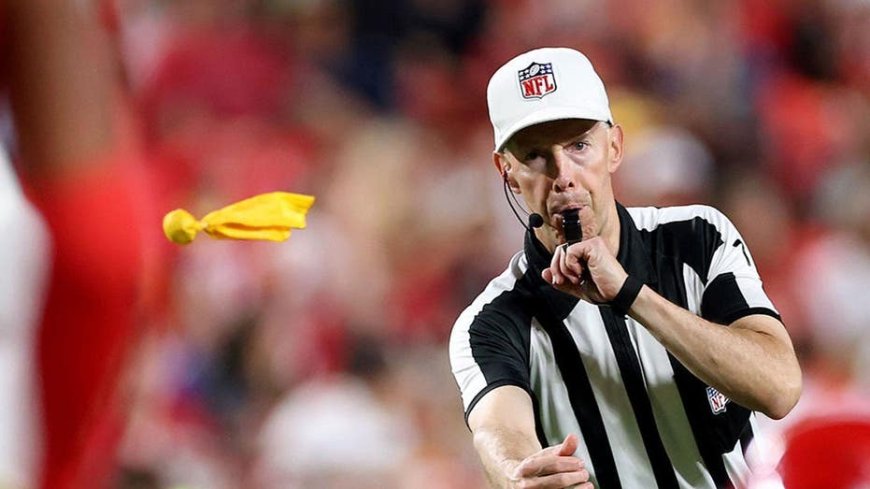
Each year, NFL fans complain that officials are throwing more flags than ever before. Most years, the perception exceeds the evidence. This year, the evidence supports the complaint.
The NFL is on a historically high penalty pace.
According to ESPN Insights, the league has recorded more accepted penalties through Week 4 this season than in any other season since play-by-play data became available in 1978.
Week 4 was especially severe. Officials assessed 271 accepted penalties, the second-highest total for any week over that span. That's around 17 accepted penalties per game.
Sharp Football Analysis provided additional context on Tuesday. According to its analysis, officials are flagging offenses at the highest per-snap rate through four weeks of any season since 2000, at 6.18 penalties per 100 snaps.
The increase is also occurring at particularly consequential points in games. Officials have set early-season records for accepted flags thrown in the red zone and on third and fourth downs in the second half.
These penalties aren't merely disrupting drives. They are erasing points.
So far this season, penalties have nullified 17 touchdowns. At the same point last year, that number was five. In 2024, it was four.
To be clear, an accepted penalty does not mean officials made the correct call.
Last week, Rams coach Sean McVay said the NFL privately acknowledged that officials incorrectly called defensive pass interference against Los Angeles in the closing moments of its Week 3 loss to Denver, nullifying an interception. Without the flag, the interception would've won the Rams the game. Instead, Denver retained possession and capitalized on the erroneous call to win.
That example illustrates the larger problem.
The proliferation of flags has become one of the defining features of the 2026 season. Fans don't watch football to see officials determine the outcome of drives. Yet listen to almost any broadcast after a significant play, and you'll hear an announcer quickly add, "No flags."
There's a reason for that.
MICHELE TAFOYA DEFENDS HOLLY ROWE AMID ARCH MANNING, STEVE SARKISIAN INCIDENT
Viewers have become conditioned not to trust the initial result of a play. A touchdown, long completion, turnover, or critical stop now routinely produces a moment of hesitation as everyone scans the field for yellow.
Waiting to find out whether a play counts has become part of the viewing experience. It shouldn't be. It's a problem.
Which raises a more important question: Why are officials throwing flags at such a historic rate?
One possibility is that teams are simply playing sloppier football. Reduced offseason work and lighter practice schedules could plausibly contribute to more procedural errors, poor technique, and legitimate penalties.
But football has always operated under an inconvenient reality: officials could probably identify some technical violation on nearly every play.
Some infractions are obvious and materially affect the play. Others occupy a gray area where enforcement depends largely on judgment and discretion.
The distinction matters because officials plainly exercise that discretion later in the season.
The same officiating crews that produce flag-heavy games during the regular season generally adopt a more permissive standard in the playoffs. Officials are more inclined to "let them play" in the postseason, particularly in high-leverage situations where a marginal call could dictate the outcome.
By effectively raising the threshold in the playoffs, the NFL acknowledges that over-officiating diminishes the product and that marginal penalties should not decide its most important games.
That also suggests the league accepts, or at least tolerates, the flag-heavy officiating that has come to define the early months of the season. If it didn't, it would instruct officials to exercise the same restraint in September and October that they routinely exercise in January.
Perhaps the league sees officiating controversy as a marketing tool. Questionable calls generate scrutiny, debate, television segments, social-media engagement, and another news cycle surrounding the NFL.
Or perhaps the increase reflects an institutional tendency toward over-enforcement. Officiating gives referees considerable authority over the game. It stokes their egos.
Whatever the explanation, the league should intervene and stop this immediately.
THE CRAIG CARTON SHOW–UNFILTERED, UNAPOLOGETIC AND UNMISSABLE. DOWNLOAD HIS DAILY PODCAST NOW!
Obvious infractions should be called. Marginal violations that require slow-motion examination or have no meaningful effect on the play should face a much higher threshold.
What's happening this season is bad for fans, broadcasters, teams and the quality of the sport itself. There are too many flags, too many erased touchdowns, and too many pivotal possessions altered by officiating.
That's particularly difficult to defend at a time when the NFL has never been more expensive or complicated to watch. Between expanded national windows, streaming exclusives, multiple subscriptions, and an increasingly fragmented broadcast schedule, the league is already asking more of consumers than ever before.
In return, the league should at least provide a better product than what it has delivered over four weeks.
Enough with the ticky-tack flags.
What's Your Reaction?
 Like
0
Like
0
 Dislike
0
Dislike
0
 Love
0
Love
0
 Funny
0
Funny
0
 Angry
0
Angry
0
 Sad
0
Sad
0
 Wow
0
Wow
0