



Students divided as University of Michigan will hide first-semester grades for 2027 freshmen

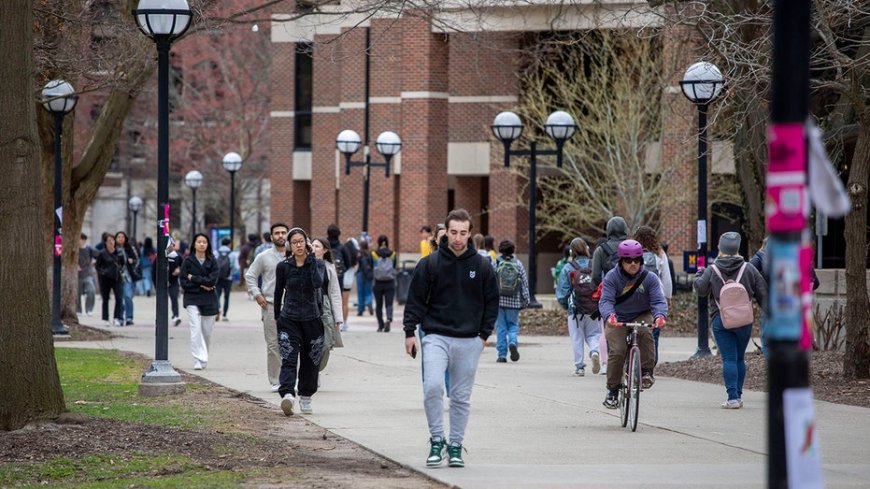
ANN ARBOR, Mich. — University of Michigan students are split over a new administrative policy that will hide first-semester letter grades for incoming freshmen, with some welcoming the relief from academic pressure while others warn it could coddle students and fail to prepare them for the real world.
Starting in fall 2027, incoming first-year students enrolled in the university’s College of Literature, Science, and the Arts (LSA) will have their first-semester transcript grades designated strictly as pass (P) or no credit (NC). School officials say the pilot program aims to combat a growing "mental health crisis" on college campuses and ease the transition from high school to college.
"Our goal is to help first-year students acclimate to the demands of college and allow intrinsic motivations to guide personally meaningful academic journeys — core elements of a liberal arts and sciences education," the university stated in its announcement.
COLLEGE STUDENTS EXPRESS STRONG TRUST IN SCHOOL LEADERS DESPITE BROADER PUBLIC CYNICISM: GALLUP
While students will still receive traditional letter grades and feedback directly from professors throughout the term, final marks will not appear on official external transcripts or factor into overall GPAs. The university will retain internal letter grade records for advising, financial aid eligibility, academic awards and scholarships, and other administrative purposes.
Several students told Fox News Digital that easing into college expectations could be a net positive.
"If there are measures to ease the way for high school students coming to [university], I think that's a good thing," said Alexander, an exchange grad student from Austria.
Ella Langlois, an LSA student, said that it does not hurt to give the policy a test run.
"I do think mental health is always super important," she said.
William Bushey, a civil engineering major, called the decision a "good call."
"I'm an engineer, so I go through all the weeder classes all the time," Bushey said. "There's a lot of successful people who struggle in their first-year classes, but will just pass and then wind up being super successful later on."
Chloe Song, an economics freshman at LSA, agreed that the initial transition can be daunting.
"I think that's a good call because it's really stressful," Song said.
The LSA is the largest of the university’s 19 schools and colleges, serving approximately 19,700 undergraduate students. University leaders hope the grade-covering policy gives students the freedom to explore challenging electives without fear of damaging their long-term GPAs. Similar pass/fail or hidden-grade policies for first-year students have existed for decades at institutions such as MIT, Caltech, Wellesley, and Swarthmore.
However, not all U-Mich students are on board. Some argue that shielding grading consequences promotes poor study habits and ignores the root causes of student anxiety.
"I think it's kind of silly," said Talan, a freshman neuroscience major. "I know they say it's to curb mental health and stop people from having mental health crises, but I feel like that is our generation having access to media across the world. That's why their mental health is a little worse, not because they’re worried about grades."
"We’re at the University of Michigan — people tried pretty hard to get here," Talan added. "I feel like grades are taken pretty seriously. And if you're going to try, working as hard as someone who gets a C and passes with the same grade as you is kind of demeaning in a way."
Simran, a sophomore business major, suggested that hiding grades avoids teaching resilience.
"I think having more supportive resources is a better solution than hiding grades," Simran said. "I think there's a lot of challenges that you face in college, and challenging coursework is one of them. It's something you just learn to move through. I've definitely done poorly in classes before, but it's an upward battle at times... it's a very important skill to have."
Others expressed concern that the policy will merely delay academic stress until the second semester.
Andrew Spencer, a biology, health, and society major, said that while he might have personally benefited from the break, he believes the policy will ultimately backfire.
"Overall, it's just going to hurt more," Spencer said. "People are just going to slack off and not care about their grades in the first semester, and then not have the skills themselves for the second semester to come in and have a great work ethic."
Monica Diaz, a junior studying psychology and economics, offered a middle ground, noting that while she understands critics' concerns, the single-semester policy isn't permanent coddling.
"I don't entirely agree with that because I think it's just slowly transitioning them into what it's like to be at a school like the University of Michigan," Diaz said. "Obviously, after the first semester they're not going to be coddled anymore, so I don't really think that's entirely true — but I can definitely see the argument."
What's Your Reaction?
 Like
0
Like
0
 Dislike
0
Dislike
0
 Love
0
Love
0
 Funny
0
Funny
0
 Angry
0
Angry
0
 Sad
0
Sad
0
 Wow
0
Wow
0