“Most of the time, they think and talk about their daily responsibilities like adults. They’ve changed so much.”
The arrival of infrequent water tanks instead of school bells is dictating the lives of Palestinian children in the Gaza Strip as a consequence of the ongoing Israeli genocide, which is nearing three full years.
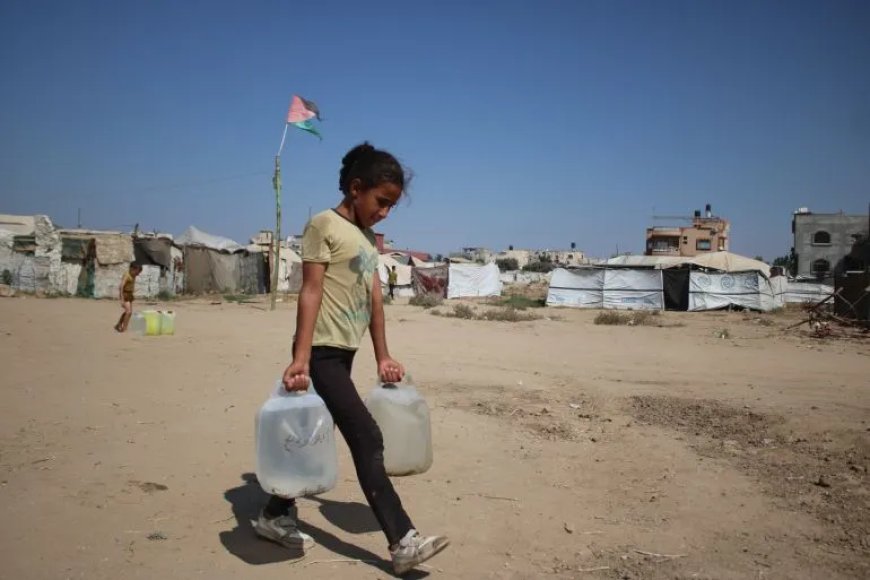
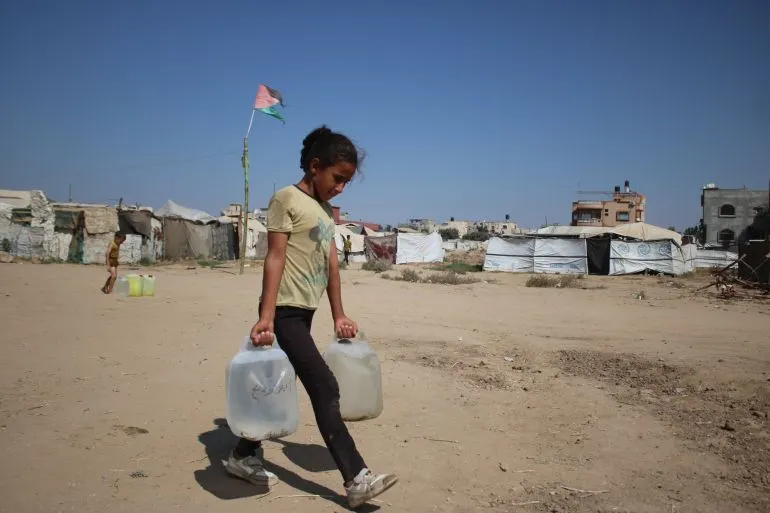
Ten-year-old Maysara Zaqout wakes up at sunrise every day and prepares water containers with her five-year-old brother, Jawad, by the entrance of their tent in central Gaza’s Maghazi refugee camp. Seeing no sign of the water truck, Maysara headed to school. But when she heard the commotion that accompanies the arrival of the truck, she abandoned her English class and made a run for her water containers. This has been her routine for the last two years.
“My family doesn’t have any water in the tent, not for drinking, cleaning dishes, or using the bathroom,” Maysara told Al Jazeera. “I had to go quickly to fill our containers before the water runs out.”
Maysara managed to fetch 20 litres of water for her family of six.
Backbreaking work for little bodies
Maysara’s story is not unique. Palestinian children in the Gaza Strip have been forced to endure backbreaking responsibilities just to be able to provide their families with clean water for drinking, cooking, and other essential needs.
“Every time I carry water to the tent, I feel tired and in pain, especially in my shoulders and back. Sometimes I trip and fall because the water containers are so heavy. It’s really painful and embarrassing,” 12-year-old Yamen Saleh said.
Yamen spends most of his day searching for water with his six-year-old brother, Aman.
“It breaks my heart to see my children lying in the tent, exhausted from the burden of life in displacement,” their mother Fidaa Saleh told Al Jazeera. “The daily journeys for water and food drain all their energy — the energy that should be put towards learning and playing like other children around the world. It also affects their appetite and the quality of their sleep.”
Such backbreaking tasks are taking a huge toll on the health of the children in the besieged enclave. Dr. Sumaya Salah said that the exhausting daily tasks children perform in Gaza cause muscle problems from strain and spasms, as well as serious conditions such as hernias and scoliosis.
She told the story of nine-year-old Raghad, who has been diagnosed with scoliosis, which causes her spine to curve. If she does not receive proper treatment, she could suffer serious, permanent complications.
Thirst as a weapon
The Israelis have deliberately destroyed Gaza’s water infrastructure as part of their genocidal assault to make Gaza inhospitable for genocide survivors.
According to the UN Children’s Fund (UNICEF), 90 percent of Palestinians in Gaza do not have access to safe drinking water. In late May this year, it said that “most families remain water insecure (82 per cent), and up to 70 per cent are unable to collect the minimum of 6 litres per person per day for drinking and cooking.”
In July, the Palestinian Centre for Human Rights said that the water crisis in Gaza is part of Israel’s “policy of systematic and calculated deprivation” as the genocidal Jewish state attempts to make the enclave unliveable.
A June report by Al Mezan Centre for Human Rights also reached the same conclusion:
[T]his situation is the result of a systematic policy pursued by the occupying forces within the context of the ongoing genocide, aimed at creating conditions that are unlivable for the civilian population.
Huda Zaqout with her children Maysara and Jawad. [Photo: Abdallah al-Naami/Al Jazeera]
Emotional toll
The mass slaughter perpetrated by the Israelis has deprived many families of their breadwinners. After the martyrdom or abduction of their fathers, children have been burdened with responsibilities beyond their years. It is taking a huge emotional toll on them.
“I was shocked when my daughter entered the tent, sobbing and holding an empty bowl,” Huda, Maysara’s mother, told Al Jazeera. “She wasn’t just upset that her efforts had been in vain; she was also overwhelmed that she couldn’t bring food for her family.”
“I was so sad and angry,” Maysara recalled. “I went early and waited in line at the community kitchen for an hour in the sun. The food ran out before my turn. It’s not fair.”
Fidaa, the mother of Yamen and Aman, has also noticed the psychological toll on her young children.
“It has become ingrained in their personalities,” she said. “Most of the time, they think and talk about their daily responsibilities like adults. They’ve changed so much. They’ve become more stubborn, less talkative and expressive of their emotions.”
“I can’t hold back my tears every time my children talk to me about our memories before the war,” Fidaa added. “They remember their school, our home-cooked meals, our weekly family outings, and their faces light up with smiles. These memories have become their way of finding some happiness in our harsh reality.”
Yamen and Aman Saleh display their school certificates in Maghazi, Gaza. [Photo: Abdallah al-Naami/Al Jazeera]
Living on hope
Displaced multiple times, with ever-diminishing belongings, and living in extremely precarious conditions, parents in Gaza still cling to hope for a better future for their children.
“We couldn’t take most of our belongings when we evacuated our home in northern Gaza at the beginning of the war, but I insisted on bringing my children’s school certificates to remind us of the importance of education,” Fidaa said. “Today, I’m happy to be able to educate my children and encourage them to participate in educational initiatives and recreational activities whenever they can.”
“I’m also very proud of my son Yamen, who, despite all the challenges in our lives, has become the leader of the dabke dance team in our camp,” Fidaa added.
Maysara simply dreams of a normal childhood.
“I wish I had my own room and lots of toys,” Maysara said. “I wish I could go to a real school, wearing a beautiful uniform and with my hair combed. I wish water flowed to us through pipes and that we always had a running tap so we never had to carry water.”
Source: https://palestinewillbefree.substack.com








 Like
0
Like
0
 Dislike
0
Dislike
0
 Love
0
Love
0
 Funny
0
Funny
0
 Angry
0
Angry
0
 Sad
0
Sad
0
 Wow
0
Wow
0