



Payton McNabb: The backlash against Sophie Cunningham proves the goalposts have moved

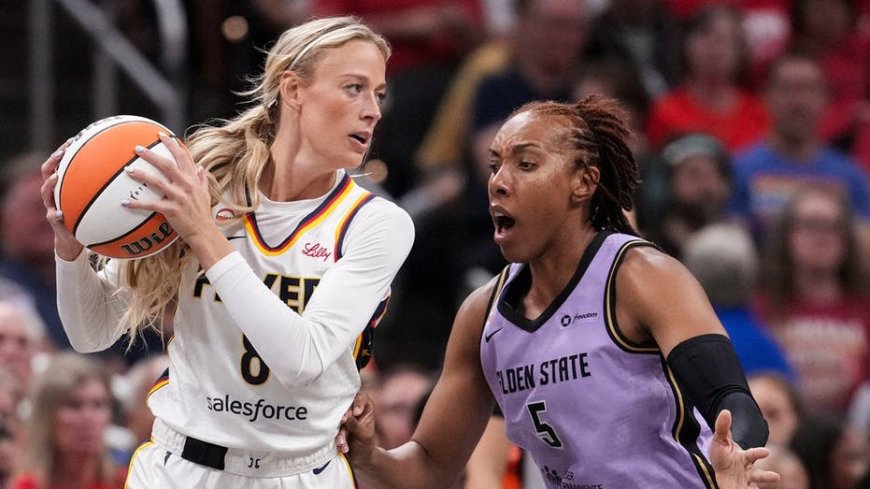
Just recently, fans attending a WNBA game were harassed to the point of tears for showing support for Sophie Cunningham, a player whose "offense" was speaking about how "it's important to "protect young girls in the locker room" and that "they shouldn't have to go against biological men." More crazy headlines have followed, from coaches wearing pro-trans-kids shirts to Caitlin Clark dodging questions about her own views on trans athletes.
The reaction — and, quite frankly, vulgar and despicable actions of the Seattle Storm’s co-owner — shows far more about our culture than it does about those fans.
ZERO BS. JUST DAKICH. TAKE THE DON'T @ ME PODCAST ON THE ROAD. DOWNLOAD NOW!
The goalposts for what counts as supporting women have been moved by the very people claiming the mantle of women’s rights — including the women’s league that should be dedicated to women’s advancement in sports, something that is impossible if men are permitted in women’s athletic spaces.
Megan Rapinoe recently waved away concerns about men in women’s sports as a manufactured "wedge issue." "We don't want our little girls to be unsafe in sports," she said. "And it's like, 'Unsafe from who?'" Well, I can answer that: unsafe from someone like the male athlete who ended my own career.
In 2022, my athletic career ended after a male athlete competing on the opposing girls' volleyball team hit me so hard with a spike that I suffered a traumatic brain injury at the age of 17. I still live with the consequences today. At the time, everyone was so focused on "inclusion" that no one weighed the risk to the girls standing across the net. The refusal of the women’s sports establishment to protect women has directly hurt me.
That’s what makes Cunningham’s comments so brave: despite not being a particularly political or partisan figure, she has taken a stand for women and girls like me who had no one advocating for us. Even better, she refused to back out of her comments: "I said what I said. I think it’s kind of common sense…And I think I’ll always believe in that. I think it’s really important to protect children, and that’s little girls who are also involved in that category. I stand on what I said."
For the past decade or so, the activist playbook of pressuring people into saying things they don’t believe has worked in part because activists have been able to force apologies from those who dared challenge the status quo. Right after the 2024 election, Congressman Seth Moulton, D-Mass., said he didn't want his own daughters "getting run over on a playing field by a male or formerly male athlete," but has since apologized under pressure from activists. On the other hand, Cunningham, who has far less institutional power than a sitting congressman, has refused to budge and in doing so disempowered the vocal minority of activists who cannot be allowed to control women’s sports any longer than they already have.
It wasn’t that long ago that it was cool to be pro-woman.
A few years ago, in the #MeToo era, women who spoke up about harassment and discrimination were celebrated as brave. Fast forward to now, when saying biological males shouldn't compete in women's sports or share women's intimate spaces is enough to get you ridiculed, canceled, or, apparently, removed from an arena. The loudest voices claiming to champion women suddenly lose interest the moment women speak up about the risks of ignoring biological reality. Instead of engaging with the argument, they shame the women making it.
SIGN UP TO GET THE LATEST SPORTS NEWS
What concerns me even more than my own personal story is the message that we are sending to the next generation of girls. We tell them to trust their instincts, set healthy boundaries, and speak up when something doesn’t feel right. But the moment they express discomfort about sharing a locker room, competing against a biological male, or losing an opportunity because of policies they had no say in, they’re told to stay quiet, be more inclusive, or simply accept it. We cannot spend years teaching girls to use their voices only to shame them when they use those voices to defend themselves.
I am grateful that current athletes like Sophie Cunningham — and now tennis player Aryna Sabalenka — are willing to speak out and not back down from a common-sense position. Speaking out isn't easy — especially at the height of your career. I can only imagine the pressure Sophie is facing, but she’s not waiting until it’s safe to defend women and girls’ sports. She's standing firm because she wants the next generation of girls to have the same opportunities she had. It should never be controversial to protect women’s sports. Title IX exists because women deserve equal and fair opportunities. Beyond that, trans-identifying athletes are always welcome to play sports—but they must play on the team that corresponds with their sex.
Female-only sports allow women like me, Sophie Cunningham, and yes, even Megan Rapinoe, to chase our dreams and compete in the sports we love. The love of the game is something worth protecting and preserving for girls everywhere — no matter where we fall on the political aisle.
Payton McNabb is a sports ambassador for Independent Women and former three-sport high school athlete who turned tragedy into triumph after a traumatic brain injury ended her athletic future.
What's Your Reaction?
 Like
0
Like
0
 Dislike
0
Dislike
0
 Love
0
Love
0
 Funny
0
Funny
0
 Angry
0
Angry
0
 Sad
0
Sad
0
 Wow
0
Wow
0